
Fields in Macon Tax Records
Every entry in Macon County property tax records starts with a parcel card. The Revenue Commissioner keeps that card. The card splits land characteristics and values from building characteristics and values. That split matters. An improvement can change while the land stays the same. The county estimates its system covers about 22,500 parcels. That figure does not mean every historic card or supporting document is online. A tax record can show a billing name, class, exemptions, and the values used for the current tax year. It cannot establish legal title.
| Field | What It Shows | Where |
|---|---|---|
| Land and improvement value | Separate value components kept on the property card | Revenue Commissioner CAMA |
| Appraised value | County estimate of fair and reasonable market value | Revenue Commissioner CAMA |
| Assessed value | Appraised value multiplied by the state class ratio | Revenue Commissioner CAMA |
| Exempt and taxable value | Relief applied and the remaining tax base, when displayed | Parcel card and Revenue office |
| Bill and payment status | Current charge, payment, or delinquency information | County tax search and office |
Appraised value is not the last sale price. Assessed value is a statutory calculation used for taxation. A deed may state consideration. A private appraisal estimates value for one purpose and date. These numbers can differ while every record is still right. Check the tax year shown. County guidance warns that online tax-search material may be dated and values can change before finalization.
Search Macon County Tax Cards
The official Capture CAMA property search is the online entry point for Macon County property tax records. Begin with a street address. Then save the parcel and account identifiers the application returns. The screens can change, and the county does not state which search fields are mandatory. If the web shell fails, call or visit the Revenue Commissioner at 210 North Elm Street in Tuskegee. The main office number is 334-724-2603, and the appraisal office is 334-724-2607.
The card typically displays the owner label, mailing and situs addresses, parcel and account numbers, class, land and improvement value, appraised or assessed value, exemptions, taxable total, tax year, amount due, legal description, and map or sale-history links when rendered. Not every field appears on every Macon result. Leave blank fields blank rather than filling them from assumption.
The official property-search screen is where you reach the county tax card:
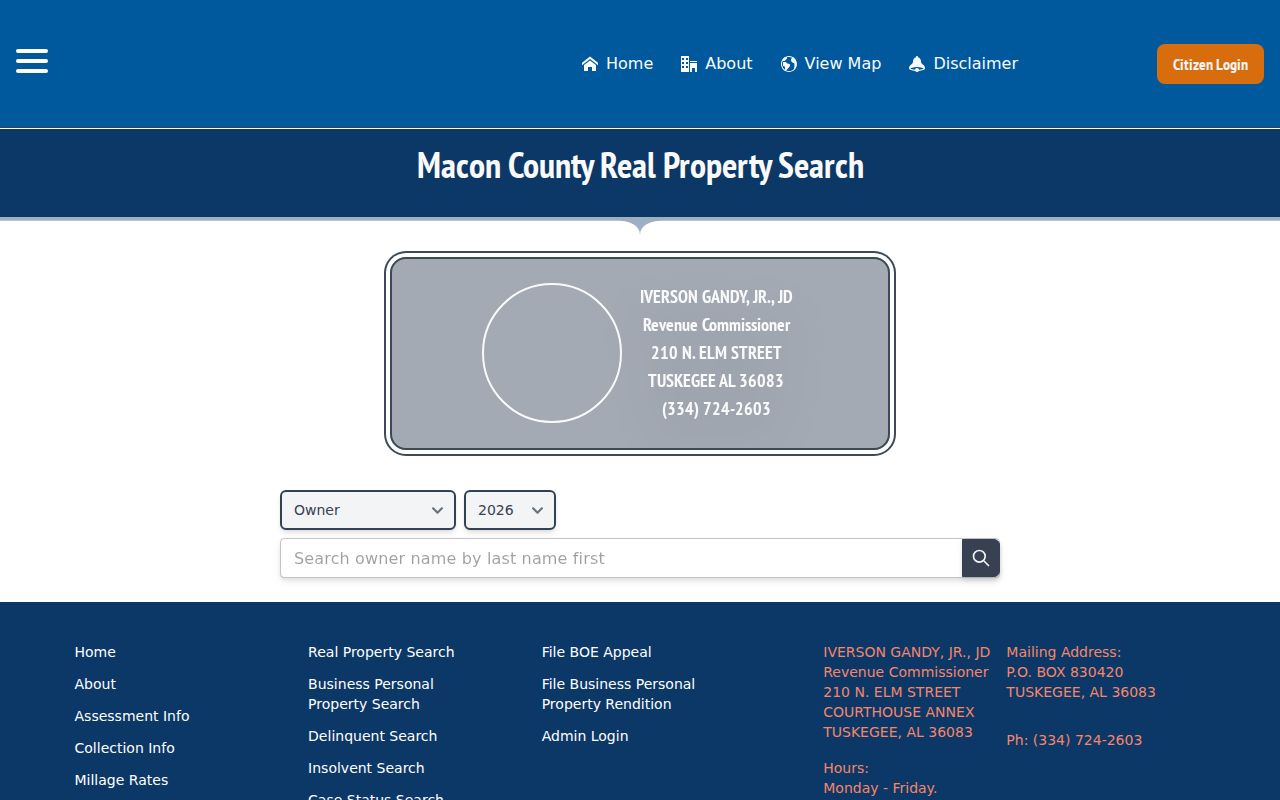
The screen is only the doorway. The parcel card and its displayed tax year still control what the result proves.
Look Up a Macon Tax Bill
A bill lookup works best as a short audit rather than a one-field check. Keep the address, parcel number, tax year, and access date together. The county says taxes use state-approved values as of September 30 of the prior year. Bills become due October 1 and are delinquent after December 31. Those dates explain why a current deed, assessment name, and bill name may not move in lockstep.
- Search CAMA by the current address and record the parcel or account number.
- Open the county Tax Search and Pay route and match the identifier and tax year.
- Read land, improvement, class, assessed, exempt, and taxable fields together.
- Check whether the bill is current, paid, or delinquent without treating status as title evidence.
- Contact Revenue when a payment, name, or mailing address does not reconcile.
- Appraised value
- The county estimate of fair and reasonable market value for assessment purposes.
- Assessed value
- Appraised value multiplied by the applicable Alabama property class ratio.
- Mill
- One-thousandth used in the tax calculation; local millage depends on the parcel's districts.
- Tax lien
- A claim arising from unpaid taxes, not a deed or immediate proof that ownership changed.
Note: Online payment carries a 2.3% Certified Payments fee; the county publishes no current card-copy or office-copy fee.
Alabama Classes Shape Macon Tax
The Alabama Department of Revenue assessment guidance supplies the formula behind Macon County property tax records. Appraised value times the classification ratio equals assessed value. Class I is assessed at 30%, Class II at 20%, and Class III at 10%. Class IV covers automobiles and pickups, which sits outside the real-property focus here. Current-use treatment can also affect qualifying agricultural, pasture, or timber land.
Millage is then applied to assessed value, with exemptions reflected in the taxable result. Rates vary by city, school, or other district. A countywide example will not calculate one parcel's bill. Match the tax card to its jurisdiction fields and the current bill. A formula explains the method; only the parcel record provides the inputs.
Note: Classification and exemption are separate fields. A lower taxable amount does not by itself mean the appraised value fell.
Macon County Annual Reappraisal
Macon County describes an annual reappraisal process. It also sets a sales-ratio compliance target of 98% to 102% in each valuation zone. The target measures how assessed work tracks qualifying sales across a zone. It is not a promise about any single parcel. No parcel would necessarily sell for the number on its card. Changes to structures, land use, classification, or the valuation model can each affect different portions of the record.
Compare the current card with the prior year's notice. Keep photos, repair estimates, a survey, and truly comparable sales handy. That helps when a material fact looks wrong. Ask the appraisal office whether a field is preliminary or final. The county itself cautions that values may change before they are finalized. A dated copy beats an undated number copied into notes.
Prior Names on Macon Bills
A Macon County tax bill sometimes still carries a prior owner's name long after a sale. That gap is normal. Billing and title are two different things. The deed may have been recorded after the assessment date, the assessment record may lag behind, or the tax notice may simply follow an older mailing record. A mortgage company can show up too, because it handled the payment. None of those entries changes who owns the land.
Start with the parcel number and the legal description, not the printed name. Then pull the newest Probate deed and read its grantee line. Macon County asks purchasers to report a complete legal description and a new assessment. A mailing-address change goes through the county contact route, which offers an option covering all properties at once. New mail is not a new owner.
Billing-name myth. A name on the bill is a tax clue, while the latest recorded deed is the stronger transfer record.
Macon Exemptions and Current Use
Exemptions shrink the taxable amount when a parcel and an applicant qualify under Alabama rules. Read the parcel card itself. Its exemption and taxable-value fields tell you more than any assumption. Owner occupation alone did not necessarily produce the relief. Current-use valuation is a separate concept for eligible agricultural, pasture, or timber property. It values the qualifying use under the state's framework rather than applying a generic discount.
The county property office handles every application, eligibility question, missing exemption, and current-use issue. Bring the parcel or account number. Ask which proof applies and what filing date governs. Macon County publishes no complete fee or form schedule. Treat no unofficial deadline as binding. Buyers should also confirm whether an existing benefit survives a transfer. Status on an old bill may not carry forward.
Macon Delinquent Tax Records
Delinquency unfolds in stages. Macon County posts current notices on its official news page, including a 2026 list for 2025 delinquencies and an online auction set for April 9, 2026. A published list shows the stated tax status at that stage of the process. It is not a deed. Treat it as evidence, never as a final owner list.
The trail runs from the due date to delinquency, then notice, auction or lien, redemption, and only later, when applicable, foreclosure judgment or deed. Keep the dates from each stage. A taxpayer can pay or redeem as the law and the notice allow. Title questions still demand recorded Probate instruments. Current notices may name owners or heirs, mortgagees, purchasers, judgment creditors, lienholders, tax payers, probate heirs, or business interests, since those parties may require notice. Appearance there does not make anyone an owner.
Limits of Macon Tax Search
The county labels its tax-search material informational, potentially dated, and subject to errors or omissions. It also states that the material is not a legal property description. That warning matters. A street address may be missing, or a value may still be in flux. A map link may also seem to conflict with the deed. Report an error with the parcel and account number. Then compare the legal description in the recorded instrument.
When online access fails, try the Revenue Commissioner counter, a call, postal mail, or a narrow public-record request. County-published office hours run Monday through Friday, 8:30 a.m. to 4:30 p.m., with collections through 4:00 p.m. Confirm before traveling. A request under Ala. Code §36-12-40 should name the custodian and the parcel. It should also list the tax year, the record category, and the inspection or copy format. Alabama sets no fixed statewide response deadline.
Appeal a Macon County Assessment
A value-change notice starts the clock in Macon County. Owners generally get 30 days from that date to file a written appeal with the Board of Equalization. The board can lower the value, raise it, or leave it alone. A strong filing names the parcel, points to the disputed field, states the correction wanted. It backs the claim with evidence. Comparables work best when they match the location and the use. They should also match the physical traits of the property. Photos, repair estimates, or a survey can fix a factual error. So can a corrected building inventory. All work far better than a simple claim that the tax bill is too high.
A second step goes to Circuit Court, usually within another 30 days. County guidance adds that paying the tax by December 31 keeps that appeal alive. Posting a bond for twice the amount works as well. Notice dates and procedure control the real window. So confirm any deadline with the Revenue Commissioner or the Board rather than counting from an online search date. The Alabama property-tax overview gives useful state context, yet the local notice is what governs the parcel.
Appeal window. File the written Board of Equalization appeal within 30 days of the value-change notice and preserve every dated submission.
Property tax records hold the values being argued. They cannot substitute for a timely filing or proof that the Board actually received the appeal.