
Reconstruct Macon County Former Owners
Building a backward timeline keeps former owners in order. It also exposes any gaps in the chain. Start from the newest confirmed transfer. Then add one row for each earlier step. Carry the same legal description through every deed record as you go. Treat the dates below as fields to capture rather than sample transfers.
| Transfer Date | Grantor to Grantee | Deed Type | Book/Page |
|---|---|---|---|
| Newest deed date | Prior owner to current grantee | As indexed | Exact reference |
| Next earlier date | Earlier owner to prior grantee | As indexed | Exact reference |
| Deed-book date | Repeat with same tract | As written | Volume and page |
Use the Macon Probate land-record route for the index entry.
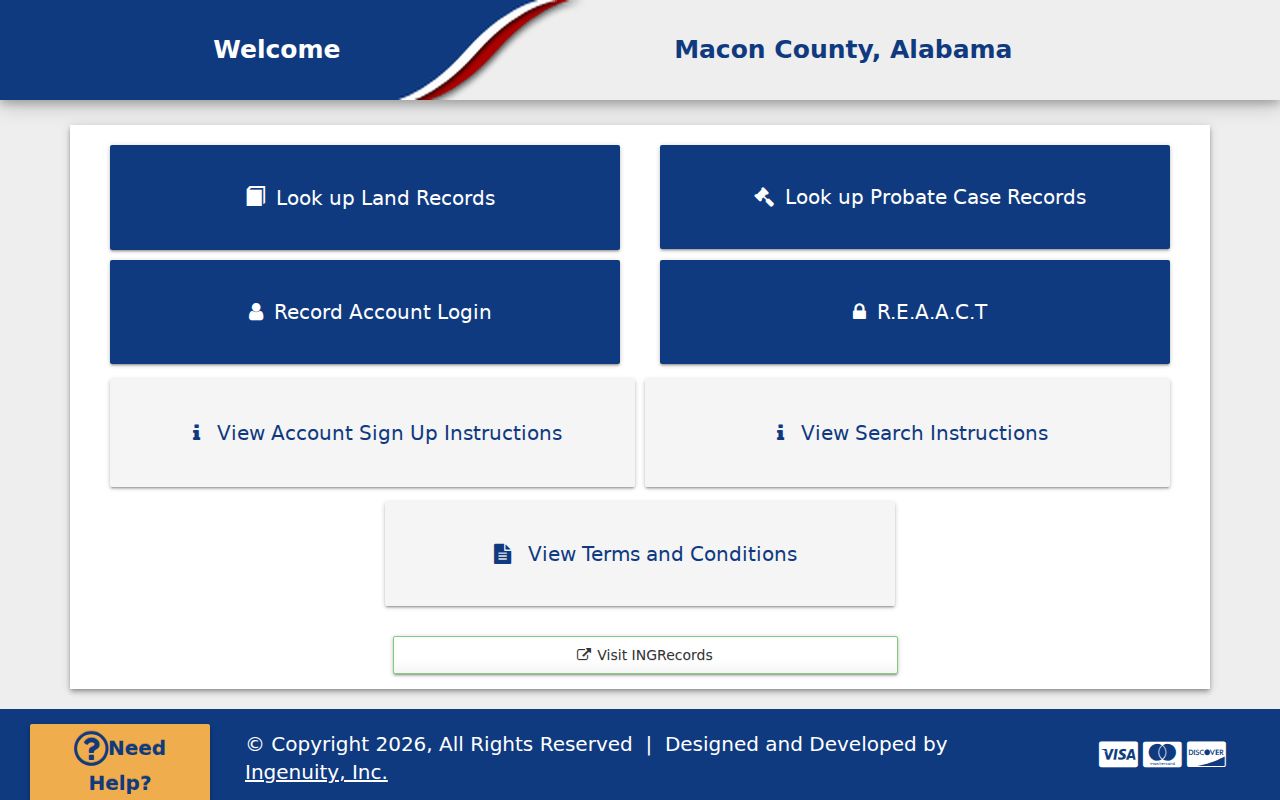
The entry shows the official route into Macon County land-record searching. Use it to reach the deed images. If the account system does not expose the image or the first year available, contact the Judge of Probate at 101 E Rosa Parks Avenue, Suite 101, Tuskegee, 334-724-2611.
Keep Macon County Land Continuous
A former owner belongs in the chain only when the land itself stays the same. Compare lot and block, section-township-range, metes and bounds, acreage, and adjoining-owner calls across each deed. A split can make a name sequence look complete. But it may actually follow a different tract.
Rely on the deed wording and the recorded plat. The tax-search notice states its material is informational and not a legal description. A current parcel ID helps you locate land. But older deeds may predate that number.
Sort Macon County Transfer Types
Warranty, quitclaim, correction, and fiduciary deeds each carry different weight. A correction deed may only repair text. An estate deed may show a representative acting under separate probate authority.
- Grantor
- The party conveying an interest.
- Grantee
- The party receiving it.
- Chain of title
- The ordered transfers for the same land.
- Reverse index
- The index searched in the opposite party role.
- Quitclaim
- A transfer of whatever interest the grantor holds, without a warranty.
Separate Macon County Record Branches
Mortgages, releases, and liens often carry the same party names as deeds. They record debt, not ownership. A mortgage shows financing; a release shows satisfaction. Track each branch of the Macon County property records on its own line, because none of these instruments belongs in a previous-owner timeline as a conveyance.
Court and probate files answer different questions. A probate file explains a fiduciary's authority, while a judgment explains a court ruling. For the instrument that actually moved the land interest, return to the deed index.
Expand Macon County Place Names
Place names in Macon County have drifted over time. That drift can quietly sink a property search. Records tied to the Notasulga area sometimes carry the older label Moores Crossroads. Shorter-area documents may reference Cross Keys or Old Federal Road instead. Running a search under both the modern and historic names widens the net. The legal description on the deed is what settles the question.
The University of Alabama historic-places inventory can sharpen that vocabulary. It shows which names belong to which era of Macon County property records. It is context, though, not proof of a transfer. Treat it as a dictionary for deed-book language rather than evidence of ownership.
Note: A place-name match is only a lead. The deed description must tie it to the same parcel.
Go Back Through Macon County Deeds
Work backward from the newest deed. Its grantor is the former owner you investigate next. Log every name, variant, date, and deed reference as you go through the Macon County deed records.
- Find the current grantee's acquisition deed.
- Copy its grantor, legal description, date, and reference.
- Search that grantor as an earlier grantee.
- Repeat until the index ends, then continue in deed books or microfilm.
- Book and page
- The volume and leaf reference.
- Legal description
- The land wording that survives address change.
- Chain gap
- A point where the next linked transfer remains unfound.
Route Macon County Archive Gaps
When the local deed trail runs out, pin down the exact missing span. Do this before writing to an archive. Tuskegee University's local collections hold the land books, telephone directories, and Macon County historical documents. The Alabama Department of Archives and History keeps county subject files and accepts research requests. Auburn's microfilm adds ledger, court, and county material.
These collections link names, places, and dates. A directory entry or tax ledger is still not a deed. Use it to frame the next grantor or place-name search. Then return to Probate for the recorded conveyance. A strong request cites the last known owner of record. It should also cite the deed reference, the tract wording, and the years sought.
Record Macon County Chain Gaps
Good notes stop you from searching the same dead end twice. For every former owner in Macon County, log the exact spelling you queried. Record the role, the date range, the deed type, and any legal-description match. Keep a transfer tentative when only a tax roll or archive source backs it. A chain that jumps between surnames is rarely proof of a lost sale. Before assuming one, check correction and fiduciary instruments. Then test spelling variants and old place names. The honest endpoint of any Macon County property records search is the last verified deed. Stop there, not at the oldest name that merely sits near the parcel.
Reconnect Macon County Platted Lots
A subdivision plat can rescue a chain. It works when the street number changes but the lot and block hold still. Pull the plat the deed cites. Compare the lot number, block, street dedication, and adjoining lots. That drawing gives recorded plat context, not a field survey of today's monuments. Old metes-and-bounds deeds deserve full transcription of every call. Section, township, and range can be checked against the county section map for broad orientation. A mismatch belongs in front of Probate or Revenue. Never quietly treat it as a typo.
Use Macon County Land Books
Tuskegee University's 1832 survey and its 1890 through 1919 Lot and Land Books are unusually specific local fallbacks. They show how a place or land entry was described in an earlier period. A name found there can point the way to the next deed-book search. Yet a land book entry does not fill the conveyance chain by itself. Record the collection title, page, date, and spelling exactly as they appear. Then compare that entry with the Probate deed reference and the same tract description. The comparison preserves the line between historical context and a recorded transfer of ownership.
Follow Macon County Estate Transfers
A former owner may vanish from the ordinary sale pattern after death. Probate can establish fiduciary authority, while a later deed records the actual conveyance. Those are linked but separate steps. Restricted death-record details are never needed to trace the land. Search for fiduciary deeds and estate names, including spelling variations. When an executor or administrator signs as grantor, note the capacity exactly. Never swap the named estate or fiduciary for an inferred heir. Do that only when a public instrument in the deed records supports the statement.
Test Macon County Name Variants
Macon County deed indexes often split a single owner across several entries. Initials, suffixes, married names, and entity punctuation can each hide a match. Run the likely variants one at a time and note each query you make. A broad surname hit means little on its own. The date and legal description must tie it to the tract before it earns a place in the chain of title.
Companies need extra care. Alabama Secretary of State entity records can confirm an exact business name and its standing. They cannot show personal ownership of the real estate by an officer or registered agent. The deed itself remains the authority on the grantee of record. That authority holds in Macon County property records.
End Macon County Chains Honestly
A Macon County property search can dead-end for several reasons. The online index stops. A book reference is unclear. The tract was split, or the family name changed. State plainly which one applies rather than papering over the gap. Record the last owner of record you verified, the deed date and book reference, the exact legal description. Also note the next source still unchecked. That discipline beats forcing a name into the chain of title. It also lets a later researcher pick up at the real gap in the deed records. That saves starting over.
Extend Macon County Ownership History
Treat the online index as a starting layer, not the whole archive. Note where your parcel search actually ends. Then move to the Macon County Probate Office for the earlier conveyance books. Two regional collections reach much deeper. Tuskegee University holds a digitized 1832 county land survey. It also holds Lot and Land Books covering 1890 through 1919. Auburn Special Collections describes three microfilm reels of Macon County records. These span 1837 to 1930 and 1866 to 1920.
The Tuskegee University land-book collection can orient older ownership research. Alabama Archives accepts research inquiries. Treat these as fallback clues. They are no substitute for the conveyance chain built from actual Macon County deed records.
Coverage limit. Macon County's online start year is not verified. Check the cutoff and continue in deed books, microfilm, or archives.
Former-owner research in Macon County serves real purposes: house history, estate work, and purchase diligence. Never use property records to stalk or harass anyone. If a gap appears, preserve it honestly with the last known grantor, the date and reference, and the name of the next custodian to consult.