
Recognize Macon County Deed Types
A deed's label tells you what kind of instrument was filed. The text of the document still controls. Macon County deed records also hold mortgages, releases, easements, plats, and liens within the wider land-record system.
| Deed type | What it does | Common research use |
|---|---|---|
| Warranty deed | Conveys an interest with stated covenants | Following an ordinary transfer |
| Quitclaim deed | Conveys the grantor's interest without the same warranties | Resolving or changing a claimed interest |
| Fiduciary deed | Records a transfer by an authorized estate or fiduciary | Tracing an estate-related transfer |
| Correction deed | Corrects stated details in an earlier instrument | Reconciling names or descriptions |
| Easement | Creates or records a limited land-use right | Researching access or utility rights |
A mortgage finances property rather than conveying full ownership. Track its release or satisfaction as a separate instrument.
Use Macon County Probate Records
The Macon Probate online-services page is the county's official entry point for land records and probate case files, routing users into an ING Records account and search environment. The static page does not state how far the historic coverage reaches, what images cost, or which search fields the live system requires. The Judge of Probate sits at 101 E Rosa Parks Avenue, Suite 101, Tuskegee, AL 36083, and answers the phone at 334-724-2611. Use the counter or a call whenever an account gate blocks an image. Staff can also sort out an unclear index result or an older book left off the online system. The official Probate landing page identifies this county route into the records.
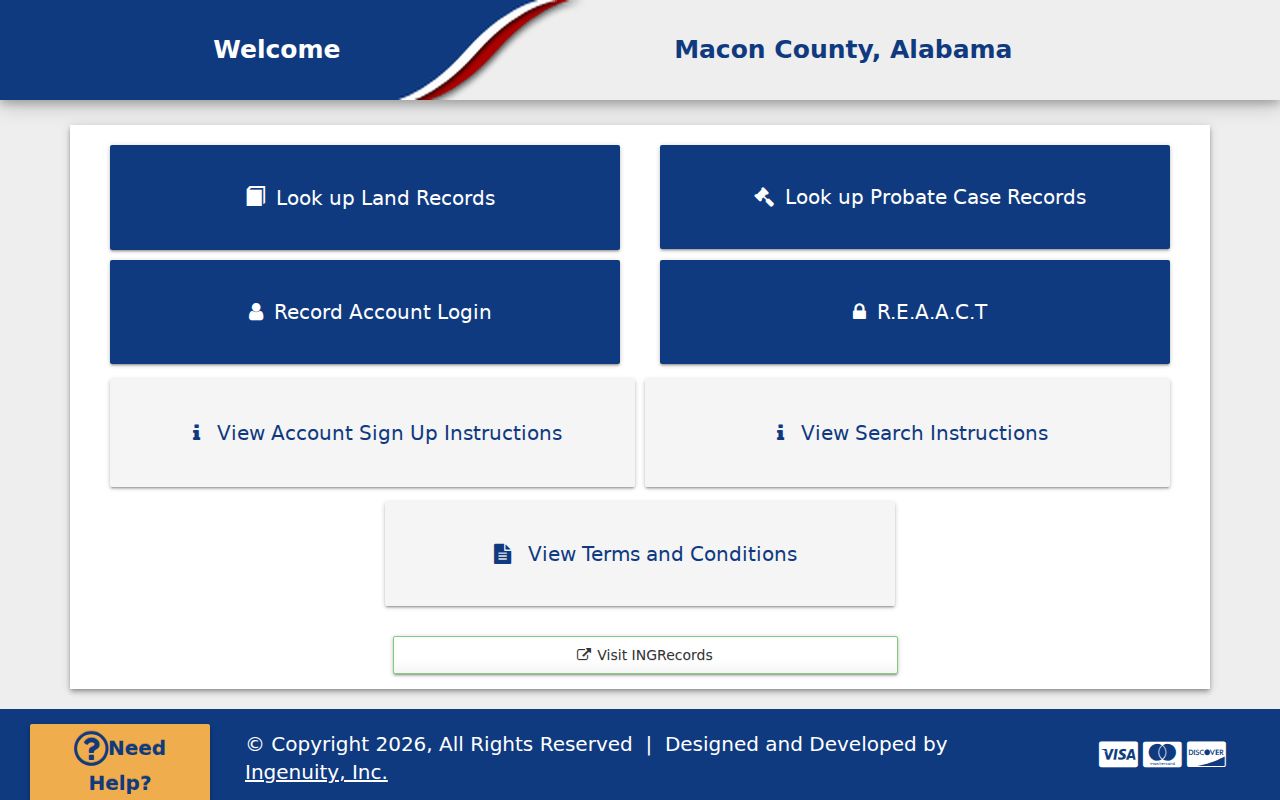
The landing screen confirms access, and staff can explain copy and certification options for any specific recording reference.
Walk Macon County Deeds Backward
A chain of title is simply the sequence of recorded transfers touching one piece of land. Find the most recent plausible deed first. Then walk backward one transfer at a time.
- Use CAMA to collect the current owner label, parcel number, and abbreviated legal description.
- Search that owner as grantee in the Probate land-record index.
- Open the newest plausible acquisition deed and record its grantor, date, legal description, and book/page or instrument number.
- Search that grantor as an earlier grantee.
- Repeat while matching the land description at every step.
Names by themselves will mislead you. Family members share names, entities shift their punctuation, and one party can hold several tracts at once.
Decode Macon County Deed References
Think of the recording reference as the retrieval key the index hands you. Give it to Probate exactly as it appears.
- Grantor
- The party conveying the recorded interest.
- Grantee
- The party receiving the recorded interest.
- Book and page
- A volume and page reference for the recorded document.
- Instrument number
- A unique filing reference used by a recording system.
- Chain of title
- The linked sequence of transfers for the same land.
A deed reference on an assessment card is only a lead; verify it against the land-record index and the recorded instrument itself.
Match Macon County Legal Descriptions
Street addresses change over time. But the recorded legal description exists to identify the land itself. Macon County records may use lot and block references. They may also use recorded plats, or section, township, and range language. Check every link in the chain. Two deeds with matching parties do not automatically cover the same parcel. The county section map offers broad orientation when a description is section-based.
The map can flag a mismatch, yet it replaces neither a deed description, a recorded plat, nor a survey.
Follow Releases and Easements
Ownership deeds are not the end of recorded land research. A mortgage carries its own release or satisfaction. An easement can govern access or utilities without changing the assessed owner of record. A plat supplies the lot framework a deed cites. Run the same party names and recording references through the index for related instruments. Include the land description too. An encumbrance is not active just because the original filing exists. Look for the later release, assignment, satisfaction, court order, or correction. Note: A deed and a mortgage can share parties and dates while documenting different legal interests.
Research Historic Macon County Deeds
The start of the county's record reaches well beyond what is online. Tuskegee University Archives holds an 1832 county land survey. It also holds digitized Lot and Land Books covering 1890 through 1919. Those are strong aids when a current description points toward an earlier land system. The Alabama Department of Archives and History keeps Macon County subject files. Auburn Special Collections lists three microfilm reels of county materials. One spans 1837 through 1930. Another covers 1866 through 1920. Tuskegee University also lists county census reels for 1870, 1880, 1900, and 1910. Its newspaper clipping files run from 1899 through 1966. Such sources can explain a name, a road, or an old tract. They never substitute for the deed volumes held through Probate.
Account for Macon County Boundaries
Macon County dates to 1832. Part of its territory helped form Lee County in 1866. The county's present shape cannot be projected backward without checking the deed's date. Place names also drift. Moores Crossroads may point toward Notasulga. Cross Keys and Shorters Depot may point toward Shorter. Tuskegee Institute and Tuskegee University deserve separate tests. Keep original spellings in every index search.
Request a Macon County Deed
Start with the online index or account route. If an image is unavailable, give Probate the party names and the approximate recording date. Include the instrument type, too. Add the book/page or instrument number if you have it. Ask whether inspection, a plain copy, or a certified copy is offered. Confirm the current charge. No fee schedule appears online. Alabama Code §36-12-40 backs citizen inspection and copying of public writings, subject to exceptions. A narrow parcel-and-date request is far easier to locate. A broad demand for everything tied to one name takes longer.
Know Macon County Deed Limits
Recording only proves the instrument entered the public land-record system. It says nothing about validity. A recorded deed can still rest on a defective chain, miss an interest that was never recorded, or carry errors in spelling, classification, or data entry. Read the document itself. Match the legal description against later corrections, releases, and any relevant court orders before trusting the chain, and rely on professional title and survey work for a purchase or dispute.
Recorded is not guaranteed. Macon County deed records are public evidence, not a legal title opinion, and unrecorded interests may exist.
Resolve Macon County Name Variants
A deed index follows the names written in the instrument itself. Search surname-first and ordinary name order if the portal allows both. Test initials, full given names, former surnames, and odd punctuation in an entity name. Try trustee or estate wording too. Write down each exact query. A failed search only means something after you know what you tried.
Historic place names can still help with the land description. Deeds are indexed by party. Moores Crossroads belongs to Notasulga history. Cross Keys and Shorters Depot connect to Shorter. Search Tuskegee Institute and Tuskegee University as separate strings across supporting archives and institutional records.
Never merge two same-name parties on the name alone. Compare spouses or co-grantors, recording dates, and the acquisition deed. Check the legal description and any connected mortgage or release. If a deed names an LLC, the Alabama Secretary of State business search can verify the entity record. The people who economically own it cannot be inferred from it.
Connect Macon County Court Orders
A recorded deed is not the only way land changes hands in Macon County. Court action can drive a transfer too. Estate administration, partition suits, quiet-title litigation, and foreclosure all end in a fiduciary or judicial deed. These deeds are not simple sale instruments. The Probate route handles estate records. Circuit Court cases sit with the Macon County Circuit Clerk.
Treat a court filing as a lead, not the finish line. The controlling order matters most. A complaint only makes allegations. A docket entry may show nothing more than a filing. To tie the court result into the land-record chain, read the order. Then look for the deed or certificate recorded through Probate, along with its legal description.
Statewide Just One Look sells one-case-at-a-time access, with fees. Its coverage is not published up front. When the online route runs dry, the Circuit Clerk can help identify the right public case material. That office sits at 101 E Rosa Parks Avenue, Suite 300, in Tuskegee.
Audit Macon County Deed Chains
After building a backward chain, run it forward. Every grantee should resurface as a grantor. An estate, entity change, court order, partial-interest transfer, or plain gap can explain why the name never appears. Check the land description too. A plat, split, combination, or correction deed should account for any change in the parcel language.
Keep dates in separate columns. Execution, acknowledgment, recording, assessment, and billing dates routinely differ in Macon County property records. The county cautions that a tax bill can stay in a former owner's name after a sale, so never treat the tax label as another link in the deed chain. Chase releases and satisfactions behind every mortgage. Inspect any correction deed that follows a discrepancy. A quitclaim conveys only what the grantor actually held, and a fiduciary deed deserves a check against the authority it cites. Those steps turn a name list into a documented trail through the Macon County deed records.
Bridge Macon County Archive Gaps
Electronic indexes stop somewhere. When the Macon County index ends, ask Probate which deed book continues the search. Ask which reverse index, plat cabinet, microfilm series, or in-office terminal picks up the rest. Probate publishes no complete coverage date. So skip published cutoff years.
Archives can fill the gap. Tuskegee University Archives holds telephone-directory finding aids for Tuskegee, Tallassee, Notasulga, and rural areas. It also holds county land books and census microfilm. Alabama Archives keeps Macon subject files. Auburn's finding aid describes county ledger, treasurer, court, and pension materials. Use those sources to pin down a historical address, occupation, community name, or family sequence. Then return to the county reverse index and deed books. Archive material supplies context. The recorded deed chain remains the ownership evidence in Macon County deed records.
Prepare a Macon County Request
Build any offline request around the last confirmed deed. List both party names, the instrument type, the approximate date, the full recording reference, and the parcel or legal-description clue. Ask staff which earlier volume continues the index. That focus keeps you from jumping to a different same-name owner in the Macon County deed records. It also hands the custodian a practical retrieval target.
Say whether you need inspection, a plain copy, or a certified copy, and confirm the current charge before ordering, since Macon County posts no fee schedule online. Keep the staff response with your deed reference. Record the reply date alongside it.